Use cases and demos

Intent becomes useful when you can verify it.

These examples show the same loop in three settings: someone explains what should happen, Amy makes the interpretation visible, the owner corrects and approves it, and an implementer works from that shared model.

Demo 01 · Business process

Monthly invoicing without the invisible assumptions

Anna knows the process because she runs it every month. She should not have to learn process notation—or discover at the end that an AI skipped an approval.

What gets verified Who prepares and approves the invoice, what blocks sending, when reminders fire, and what ends the process.
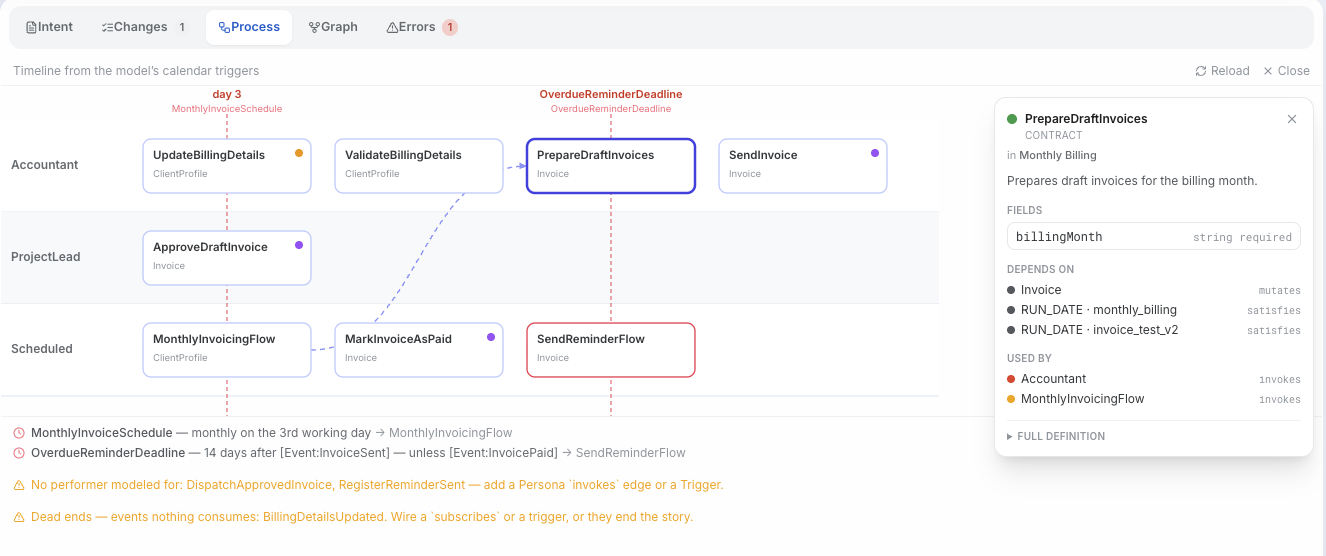
Generated by Amy · Process view Invoice Test · version 2
Amy process view for monthly invoicing, showing Accountant, Project Lead, and Scheduled swimlanes, calendar triggers, process steps, a selected contract inspector, and findings for missing performers and dead-end events.
The sequence is visiblePeople, scheduled work, approvals, and reminders are shown in one process timeline.
Every step is inspectableSelect a step to see its fields, dependencies, and who is allowed to invoke it.
Missing intent is surfacedAmy identifies process gaps instead of silently deciding what the worker must have meant.

Why the orange findings matter: they are not rendering errors. Amy found operations with no responsible performer and events with no consumer—questions the process owner should resolve before an agent executes the workflow.

Person

Anna can confirm that responsibilities and handoffs match the real process.

Implementer

A process agent such as OpenClaw reads the approved model and executes the handoffs.

Verification

If a sent invoice lacks approval, the result disagrees with the model and is reported.

Demo 02 · Software

A password-reset feature whose security rules survive the handoff

A product owner describes observable behavior. Amy separates the user journey from the guarantees a coding agent must preserve.

What gets verified Token lifetime, single use, privacy-safe responses, audit events, and the behavior when delivery fails.
amy.studio / account-recoveryUnderstanding approved
Product owner
“Users reset forgotten passwords by email. The link expires and should only work once.”
Amy
“Should the screen reveal whether the email belongs to an account?”
The missing rule becomes explicit: Always show the same confirmation, whether or not the account exists.
Behavior viewApproved by product
User
Request reset
Open emailed link
Application
Return neutral response
Validate token
Security
Expire after 24 hours
Invalidate after use
No account discoveryThe response never confirms whether an email exists.
Single useA successful reset invalidates the token immediately.
AuditableRequests and completed resets emit separate security events.
Person

The product and security owners review behavior without reading implementation code.

Implementer

A coding agent generates the UI, endpoint, storage, and tests from the approved behavior.

Verification

A reviewer checks whether the implementation exposes account existence or reuses tokens.

Demo 03 · Structured story

A mystery that remembers every promise it made

A writer can inspect characters, knowledge, clues, and reveals before asking a writing agent to draft scenes.

What gets verified Who knows each fact, when evidence appears, which reveal resolves it, and which character actions remain possible.
amy.studio / the-last-keyStory logic approved
Writer
“Mara finds a brass key in act one. It opens the observatory, but she must not learn that until the final act.”
Amy
“The current model lets Mara identify the observatory symbol in act two. That would reveal the connection early.”
The writer resolves the conflict: Elias recognizes the symbol but conceals it; Mara learns the truth only after finding his sketchbook.
Promise and reveal viewApproved by writer
Act I
Mara finds key
Symbol is unexplained
Act II
Elias recognizes it
Elias conceals truth
Act III
Sketchbook reveals link
Key opens observatory
Knowledge boundaryMara cannot act on the key’s purpose before the sketchbook reveal.
Setup has a payoffThe act-one key must open the observatory in act three.
Concealment has motiveElias knows the truth and has an explicit reason to hide it.
Person

The writer approves canon and timing while retaining creative control over the prose.

Implementer

A writing agent drafts scenes from the model without inventing conflicting knowledge.

Verification

A reviewer flags premature reveals, broken causality, and unresolved setups.

Model one process you know by heart.

Explain it to Amy, inspect the interpretation, and correct it before connecting the AI that will act.

Start with Amy